
Impact and Accountability
Impact You Can See. Measure. And Prove.
Every published impact claim must be supported by evidence. Champions for Change is designed to follow infrastructure over time, distinguish measured data from calculated outcomes and give partners information they can use with confidence.
Metric framework
| Metric | Classification | |
|---|---|---|
| Water delivered or consumed | Sensor-measured where monitoring is enabled | Show period, unit, update time, data coverage and any known interruption. |
| System operational status | Sensor-measured or verified field status | Show the latest confirmed state and timestamp. Do not imply continuous monitoring where it is unavailable. |
| People or lives supported | Calculated outcome | Show the approved formula, assumptions, reporting period and relationship to measured water volume. |
| Carbon impact | Calculated or modelled outcome | Show methodology, comparison baseline, boundaries and exclusions. |
| Water quality | Test or field measurement | Show sampling date, method, responsible party and result status. |
| Community outcomes | Survey, field evidence or evaluation | Publish only with consent, appropriate methodology and clear limitations. |
Dashboard journey
The public dashboard should allow visitors to move from Global Impact to Country, Community and Installation. Where permissions allow, a partner view can show Corporate Partner, Partner Portfolio and Installation.
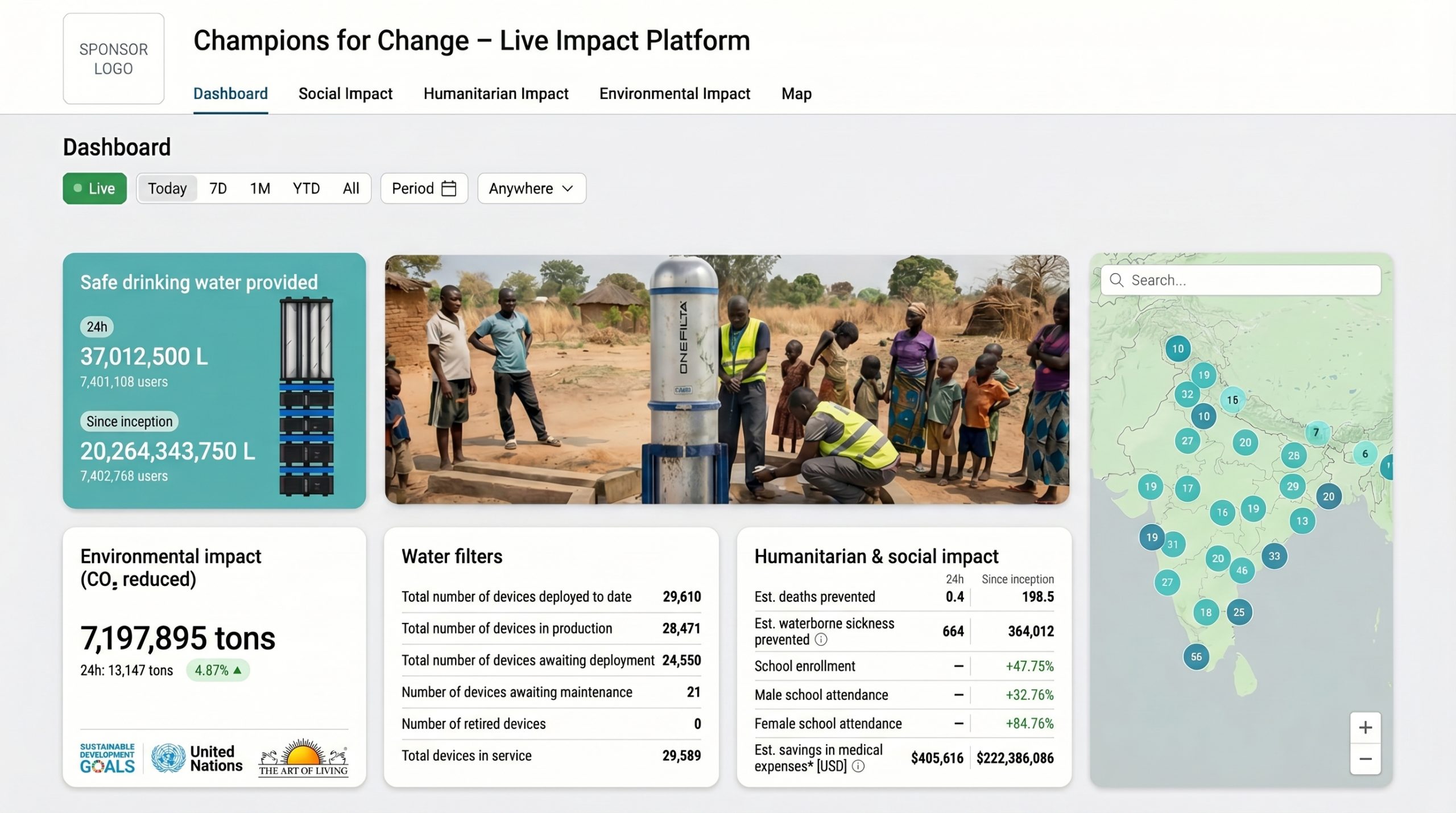
Real-Time Impact Tracker
Global impact
Demonstration view. No country, community or installation is selected.
- Reporting period
- Not yet published
- Approved records
- Not yet published
- Latest evidence date
- Not yet published
- Data coverage
- Not yet published
Explore approved countries
| Country | Commissioned installations | Water delivered · litres | Coverage and update time |
|---|---|---|---|
| No approved records available. Records will link to their supporting evidence when publication is permitted. | |||
Country evidence
Demonstration view. No country, community or installation is selected.
- Reporting period
- Not yet published
- Approved records
- Not yet published
- Latest evidence date
- Not yet published
- Data coverage
- Not yet published
Explore approved communities
| Community | Deployment status | Water delivered · litres | Evidence date |
|---|---|---|---|
| No approved records available. Records will link to their supporting evidence when publication is permitted. | |||
Community evidence
Demonstration view. No country, community or installation is selected.
- Reporting period
- Not yet published
- Approved records
- Not yet published
- Latest evidence date
- Not yet published
- Data coverage
- Not yet published
Explore approved installations
| Installation | Commissioning | Operational status | Latest confirmed update |
|---|---|---|---|
| No approved records available. Records will link to their supporting evidence when publication is permitted. | |||
Installation record
Demonstration view. No country, community or installation is selected.
- External installation ID
- Not yet published
- Country / community
- Not yet published
- Commissioned on
- Not yet published
- System status
- Not yet published
- Last confirmed update
- Not yet published
- Monitoring coverage
- Not yet published
Installation evidence
Commissioning and stewardship
No installation is published. An approved record will identify commissioning evidence, operating responsibilities and maintenance information.
Water quality evidence
- Sampling date
- Not yet published
- Test method
- Not yet published
- Responsible party
- Not yet published
- Result status
- Not yet published
Source and verification
- Evidence source
- Not yet published
- Review status
- Not yet published
- Publication permission
- Not yet published
- Known interruptions
- Not yet published
Water delivered over time
Verified readings will appear here.
No values are inferred between missing readings.
Source: unavailable · Updated: unavailable · Coverage: unavailable. Missing readings are not zero.
Measurement, calculation and evidence
Measured water and status
Water delivered is reported separately from consumed water. Published readings identify the sensor or field source, units, period, update time, coverage and interruptions.
Calculated people supported
The approved formula, litres-per-person assumption, reporting period and relationship to measured water will be shown here. No calculation is available yet.
Modelled carbon
The approved baseline, system boundaries, comparison method, exclusions and uncertainty will accompany any result. No carbon result is available yet.
No trend is inferred from totals or missing readings.
Pre-deployment state
Until the first installations are confirmed, use: Deployment data will be published as systems are commissioned, monitoring is validated and communities approve the information for publication.
Global Need and Deployment
Deployment Guided by Global Need.
Every deployment decision begins with a simple question: where is the need greatest? Site selection is guided by independently assessed community need, Art of Living Foundation field networks and technical assessment before any installation proceeds.
How locations are selected
Potential sites are assessed for water need, source-water quality, technical suitability, population served, local ownership, accessibility, safeguarding, maintenance capacity and permission to monitor and report. No location will be shown as active until it has been confirmed.
Deployment map
Explore where Champions for Change is working and follow each project from country to community and installation. Confirmed locations and their current status will appear here as projects progress.
Disaster and remote-area capability
The system architecture may be suitable for remote communities and certain emergency or recovery environments, subject to technical assessment, logistics, safeguarding and the presence of an accountable implementation partner.
Investment-to-Impact Framework
From Commitment to Measurable Community Change.
Partner funding moves through a transparent sequence of planning, site identification, technical assessment, community mobilisation, installation, training, monitoring and verified reporting. The framework shows what has been agreed, what has been delivered and the evidence supporting each reported outcome.
Framework stages
| Stage | |
|---|---|
| Partnership agreement | Objectives, scope, geographic parameters, approved use of funds, deliverables and reporting expectations. |
| Programme planning | Candidate locations, implementation partners, technical planning, safeguards and delivery schedule. |
| Assessment and approval | Verified need, water testing, technical feasibility, community engagement and final deployment approval. |
| Installation and commissioning | Infrastructure delivery, commissioning evidence, training and handover responsibilities. |
| Monitoring and stewardship | Operational data where enabled, field support, maintenance responsibilities and issue management. |
| Reporting and communication | Approved metrics, methodology, partner reports, community consent and responsible amplification. |
Impact calculator
Explore how an indicative partnership commitment could translate into clean-water systems, water delivered and people supported. Results are illustrative and will vary according to location, system requirements, operating period and the final deployment plan.
Partner reporting
Partners can receive agreed progress updates, implementation evidence, approved impact metrics and media assets connected to their programme. Reporting scope and frequency will be confirmed within each partnership agreement.
Concept reference showing how reporting, deployment tracking and partner accountability could be presented. All figures and outcomes shown are illustrative and must not be published as verified programme data.
Governance and Transparency
Purpose Requires Accountability.
Champions for Change is designed to meet the due-diligence expectations of corporate sustainability teams, foundations, government stakeholders and ESG reviewers. Each organisation has a clear and distinct role, creating visible lines of accountability throughout delivery.
Roles and responsibilities
| Organisation | |
|---|---|
| Champions for Change | Programme framework, partner coordination, programme integrity and transparent communication. |
| Onefilta | Technical design and integrity of the clean-water system, installation guidance, operating instructions, monitoring capability and technical support. |
| Art of Living Foundation | Community engagement, on-the-ground implementation support, training, site-level stewardship and local coordination. |
| World Championship of Legends | International sporting platform and responsible amplification of approved programme outcomes. |
Verification and publication
Impact information is reviewed before publication. Where appropriate, published results will include the reporting date, metric definition, methodology and the source of the underlying evidence.
ESG and SDG relevance
Champions for Change is most directly connected with UN Sustainable Development Goal 6, Clean Water and Sanitation. Depending on the programme, it may also contribute to related health and partnership goals. This connection describes the programme’s contribution and does not imply formal UN endorsement.
Due diligence resources
Prospective partners can request the current programme overview and supporting information covering technical evidence, implementation, safeguarding, impact methodology, privacy and programme governance.